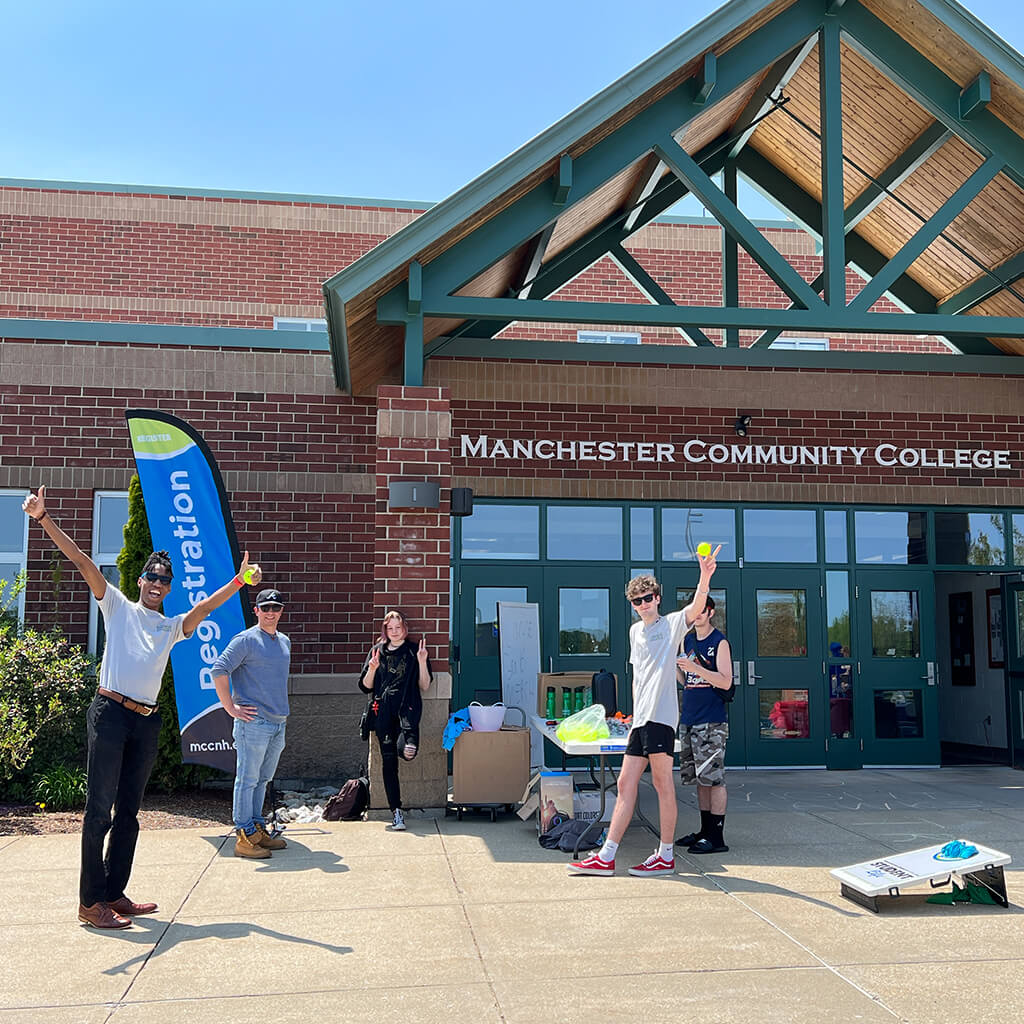
Students need to be 15+ and Sophomore Junior or Senior to qualify and register.
Earn College Credit in High School!
Manchester Community College has established an Early College initiative that specifically allows NH high school students to take MCC credit-bearing courses.
The credits students earn through Early College at Manchester Community College can be applied to a degree at MCC or possibly transfer to another college or University. This allows students to get a jump on college at a reduced rate!
Read the Frequently Asked Questions and Answers or talk to your high school guidance counselor to learn more!
Early College at MCC and Online
If you’re a high school student, age 15 or older, you can take classes directly with Manchester Community College! Courses are offered in person, hybrid and online. Taking college courses at MCC now will help prepare you academically and socially for college. You will have direct access to the college’s student and academic support offices, as well as library resources. Early College students can also participate in student organizations and attend college events. Whether taking part in the full college experience or simply taking a single class, you’ll explore college-level academics in a welcoming environment.
New Early College Online Classes
How to Register
Provides the student with an effective learning experience in personal finance, with an emphasis on helping students make sound financial decisions in the areas of budgeting, insurance, taxes, credit, investment, real estate and retirement planning.
Provides the student with an effective learning experience in personal finance, with an emphasis on helping students make sound financial decisions in the areas of budgeting, insurance, taxes, credit, investment, real estate and retirement planning.
An introduction to digital skill development within the creative process. Emphasis is placed on the application of digital skills in relation to the hands-on nature of studio art practices necessary for fine artists and illustrators. Topics may include: preparing images for a digital portfolio, building a promotional artist’s website, creating storyboards for an illustrated book, and creating digital art based on traditional hand rendering/building techniques. Drawing and creating by hand are also key aspects of the course. (Fulfills Fine Arts Requirements)
This course provides an introduction to the principles and application of pixel-based photography and students are required to provide their own DSLR camera or equivalent. Utilizing digital equipment, industry standard editing applications that correspond with traditional darkroom techniques and rules of composition, students will produce creative images based on modern and traditional photographic genres. A brief history of photography will be introduced with emphasis in critique and contemporary issues. Students will utilize today’s industry standard applications as the primary image-editing tool. The lab component includes both editing and off-campus/individual photography assignment completion. (Fulfills Fine Arts requirement)
This course introduces students to the foundational principles of computer science using the Python programming language. Students explore algorithms, problem-solving strategies, data types, control structures, and modular design while learning the fundamentals of coding, debugging, and documentation. Emphasis is placed on writing clear, efficient, and well-structured Python programs that illustrate core computer science concepts.
Provides an in-depth study of design creation relevant to the discipline of graphic design. Students will develop and expand their vocabularies in visual communication while exploring design principles and elements for solving communication problems. Assignments and discussions include creative problem solving, working to specifications, investigating alternative solutions, and the presentation of their own design pieces. Can be used as either an ARTS elective or Graphic Design course.
Starting with a survey of the night sky and the daily motions of the stars and planets, this course surveys our current understanding of the Universe. It traces the development of the tools of the modern astronomer and how those tools have led to out theories of the solar system, the life cycle of stars, the formation of elements, the formation of galaxies and the evolution of the universe.
Provides an introduction to communications media by studying the nature and history of mass communications, as well as examining the various media available to marketers within the communication process. Some of the specific media topics discussed include newspapers, magazines, radio, television and the Internet. An emphasis is placed on professions within the communications media industry, regulation of the mass media and the impact of the media on society and the global marketplace.
An introduction to Western Music. Students listen to, read about and discuss the great music of the Middle Ages, Renaissance, Baroque, Classical, Romantic and Modern periods. (Fulfills Humanities requirement)
This course is designed to introduce students to some classical and contemporary ethical perspectives, philosophies, and decision-making models. The goal of this course is to relate and apply such knowledge to modern day life; hence any concepts, models, and theories presented will also often be applied to specific problems and cases. Applications may include general ethical issues and/or more career specific issues, (to be determined by student/faculty needs or interests).
Early College Documents
Transcript Requests
To request an MCC transcript, see:
https://nighthawks.mccnh.edu/academics/registrar/graduation/transcript-requests/
Early College Frequently Asked Questions
That decision will be up to your high school. This is not a “dual” enrollment initiative. It is an avenue for motivated students to accelerate their timeline toward a college degree.
Yes, so it is important to understand that what MCC offers could be different from another NH community college.
Both Early College at the High School and Early College at MCC provide opportunities to earn college credits. Early College at the High School is taught by high school instructors at high schools. Early College courses at MCC are taught by college professors on the MCC campus, providing access to MCC labs and equipment.
To qualify for Early College, you need to be at least 15 years of age when the class starts. Meet with your high school counselor to discuss early college. This individual will help you decide if you are ready and if the MCC Early College options are a good fit for you. You must meet with a MCC representative to complete your course registration. Students must meet all prerequisites to register for some courses.
Yes. Please contact the Early College representative at MCC, Major Wheelock. Call (603) 206-8016 or email [email protected] to set up an appointment to learn more about Early College and register for classes.
The cost to take a course at MCC through the Early College program is currently half the current tuition of the college. This is a considerable discount. However, you must be prepared to pay for your own books and/or materials. You are also responsible for your own transportation to the college.
As a high school student, you are not eligible for Financial Aid. This is one reason why MCC has tried to make the tuition so affordable. Payment for the course is expected at the time of registration.
Call (603) 206-8016 or (603) 206-8012, or email Major Wheelock ([email protected]) to set up an appointment to learn more about Early College and register for classes.
Once you have registered for a college course, you are a college student and may enjoy the rights and privileges associated with this status. Among other things, you may get a Student ID, access student support services, and utilize the library. Upon course completion, you may request an official transcript.
Most courses at MCC are available to Early College students. Students must meet the prerequisite to register for classes. Some courses and programs have other registration requirements.
Every NH high school student is eligible for MCC Early College, and we are not capping participation at this time. Early College students must register before the semester starts.
Pending enrollment, MCC cannot guarantee space in any of the listed courses, and waitlists may apply. We will, however, do everything we can to avoid such a scenario.
Your Early College record is part of your official Manchester Community College transcript. As long as you successfully complete the course, and it is required of the degree program in which you enroll, you will already have completed a course toward your degree.
You should contact the Early College representative or Academic Advising. Free Tutoring is located in the Library. Campus Security is located near the Main Entrance of the college.
Please note: To qualify for Early College, students must be a at least 15 years old. The cost per class is 50% of the tuition due at the time of registration – lab fees apply for some courses. Students are also expected to pay for their own books and/or materials. Students are required to meet with their high school guidance counselor to discuss their interest in the Early College program. Students will also be required to meet with an MCC representative who will make sure the Early College registration is completed and students are signed up for the correct course.
For various reasons, students sometimes have to drop classes. If this happens to you, visit the Registrar’s Office and fill out an official drop form. Don’t just stop attending. The consequence of disappearing from a class without doing an official drop is an “F” on your transcript. Don’t let this happen to you. Be sure to review the Registration Policies and Deadlines sheet given to you at the time of registration.
Early College Contacts
For more information on Early College, contact:
Major Wheelock
Dual Enrollment Specialist/Academic Advisor
[email protected]
(603) 206-8016
Please note: To qualify for Early College, students must be at least 15 years old. Cost per class is 50% of tuition due at the time of registration – lab fees apply for some courses. Students are also expected to pay for their own books and/or materials. Students are required to meet with their high school guidance counselor to discuss their interest in the early college program. Students will also be required to meet with an MCC representative who will make sure the Early College Registration is completed and students are signed up for the correct course.