
The Technology Making Headlines at Logan? MCC Students Are Already Working with It.
The future isn’t something MCC students just read about. They get to work with it.
Have you heard about the new technology helping visitors at Logan Airport in Boston? It’s making headlines as an example of Artificial Intelligence providing customer service in a uniquely human way. Inside Terminal A stands Amelia, a 24/7 virtual assistant presented through a life-sized Proto display. Amelia can answer travelers’ questions about security, parking, directions, weather, and other airport services.
A recent Boston Globe feature describes how Amelia is programmed to answer hundreds of commonly asked questions. She can also display graphics, maps and other visual information to help travelers find what they need. The result is an experience designed to feel more like interacting with a person than navigating a traditional computer screen.
It may be making headlines now at Logan Airport, but the technology isn’t new to students at Manchester Community College.
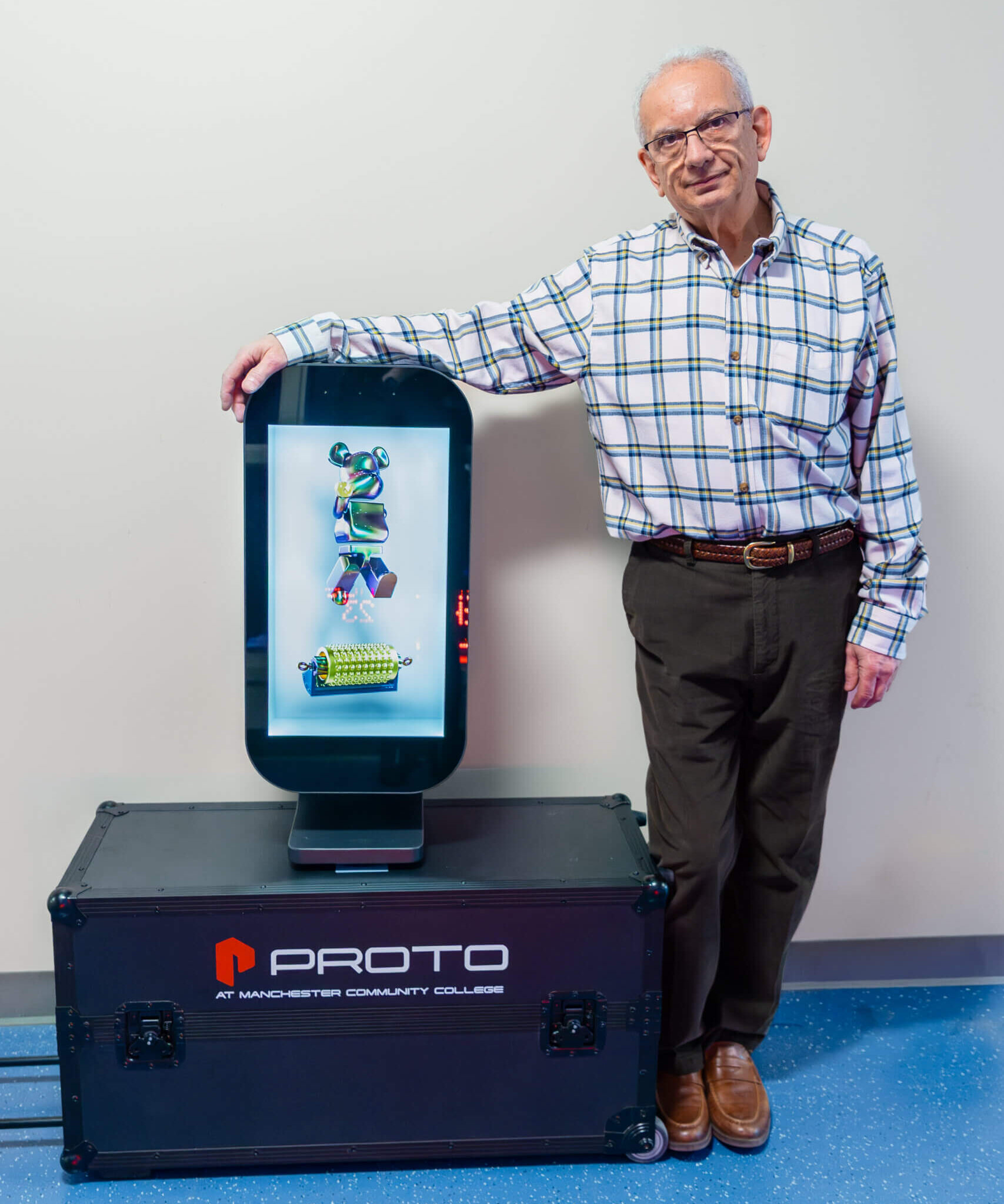
MCC Computer Science students have been working with Proto technology for more than a year, gaining hands-on experience with technology that is only now beginning to appear in highly visible public applications. MCC has had its own interactive virtual assistant on campus for three years. Along with our Proto, college instructors have been using it directly with students. Kiora, our virtual assistant, can answer student questions about financial aid. Now MCC students are involved in reprogramming Kiora to answer questions about MCC course offerings.
MCC isn’t scrambling to catch up with technology now making headlines. Students have already been working with it.
“This is exactly the kind of technology our students have already been working with,” explains Peter LaMonica, Chair of the Computer Science Department at MCC. “While the rest of the world is beginning to see AI and XR technologies appear in airports, workplaces and public spaces, our students are already learning how to program, configure, and apply these technologies. We don’t want our students simply reading about what’s coming next. We want them working with it.”
What is particularly striking about this technology is the interaction itself. At Logan Airport, Amelia demonstrates how Artificial Intelligence, digital humans and life-sized displays can change the way people interact with computers. Instead of navigating menus or searching through a website, a traveler can simply ask a question and receive both a spoken response and visual information.
At MCC, these technologies are part of a much larger area of study called eXtended Reality, or XR. MCC’s Computer Science XR degree program explores eXtended Reality, including Virtual Reality (VR), Augmented Reality (AR), Mixed Reality (MR), spatial computing, digital twins and other emerging technologies, with an emphasis on their applications in business, education, industry, and communication. Students learn to create and manage XR environments using existing platforms, develop assets for XR applications, work in collaborative XR spaces and explore how emerging technologies can be applied to real-world problems. The program is designed around practical applications rather than gaming and entertainment.
“The demand for people who understand AI, XR and emerging technologies is growing,” says LaMonica. “Our goal is to give students the foundation they need and then put the actual technology in their hands. We are fortunate to have equipment here that allows students to experiment with technologies they may soon encounter in workplaces throughout New Hampshire and beyond.”
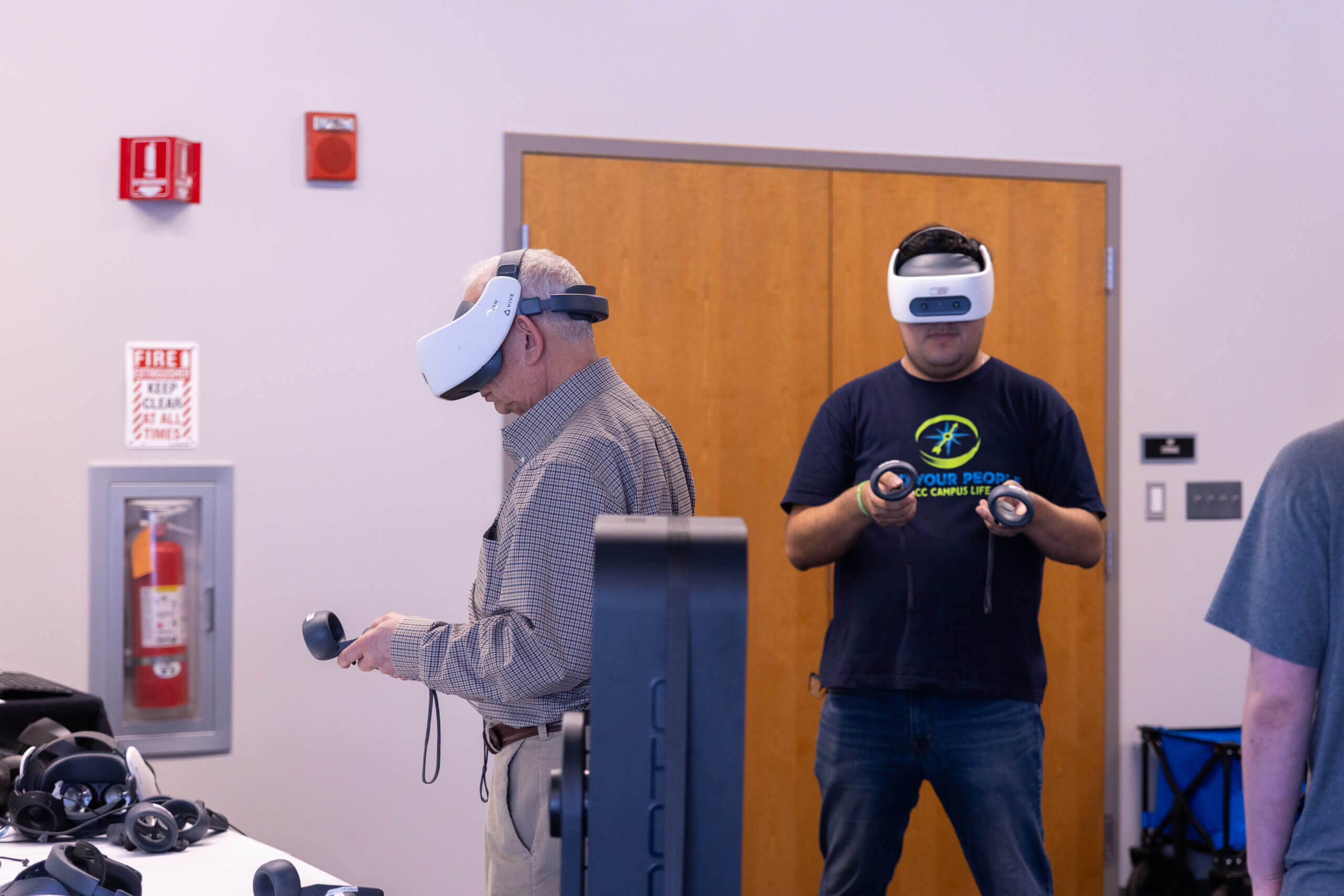
Students do not need to arrive at MCC already knowing how to build XR environments or program artificial intelligence systems. The Computer Science curriculum provides the computing foundation students need before moving into more advanced AI and XR applications.
“We can take someone who is interested in this technology, teach them the computer science fundamentals and then help them advance into AI and XR,” says LaMonica. “We’re proud to offer this kind of unique pathway at Manchester Community College.”
And there is one important difference between MCC and Logan Airport. None of MCC’s professors are holograms … at least, not on a regular basis.
MCC has used holographic technology to send a professor to a local high school, demonstrating to students firsthand how XR can change communication, education, and remote collaboration.